天若有情
Chinese navy hospital ship makes technical stop at PLA support base in Djibouti, providing medical care for troops and supporting humanitarian missions: expert_我的网站

A |
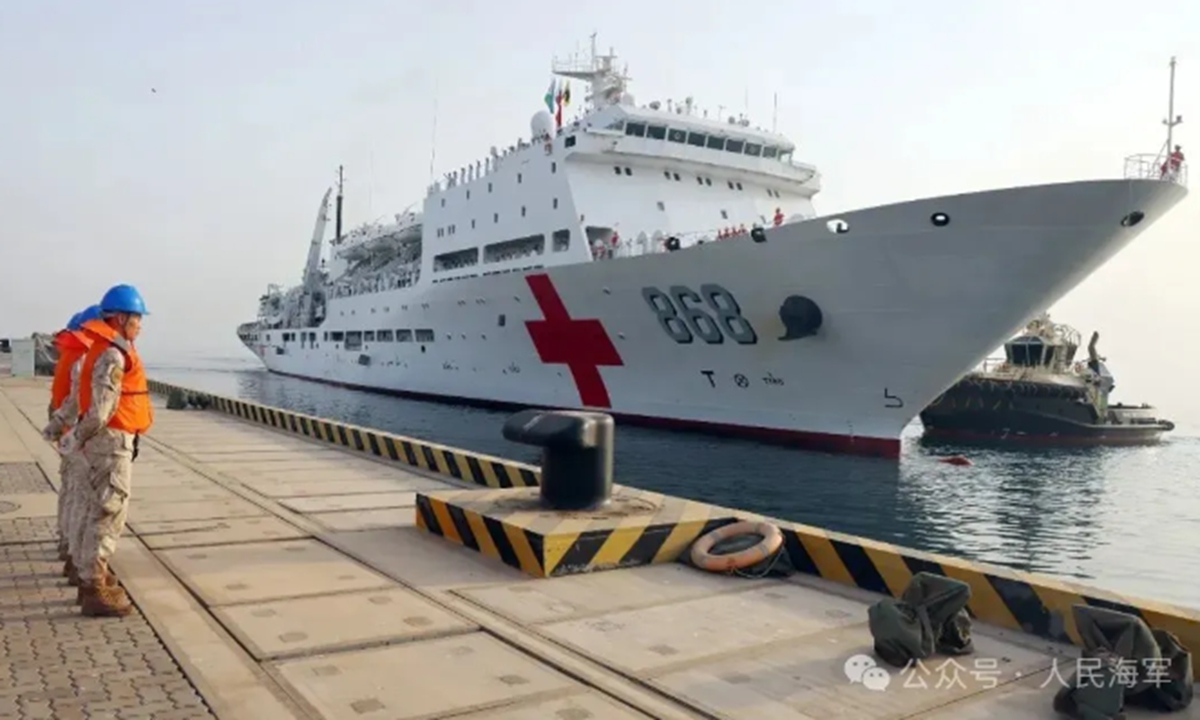
The Chinese People's Liberation Army (PLA) Navy hospital ship, Auspicious Ark, makes a technical stop at the PLA support base in Djibouti on August 11, 2026 local time. Photo: PLA Navy
The Chinese People's Liberation Army (PLA) Navy hospital ship,
Auspicious Ark, deployed for Mission Harmony-2026, made a technical stop at the PLA's support base in Djibouti on Tuesday local time, where it is scheduled to provide medical services. A Chinese expert said that in addition to addressing the healthcare challenges facing Chinese military personnel stationed overseas, the ship can extend humanitarian medical assistance locally, thereby demonstrating China's commitment to fulfilling its responsibilities through concrete actions.
The ship moored at the dock of the PLA support base in Djibouti at around 7 am, with mission personnel waving to those who came to greet them onshore. Staff from the Chinese Embassy in Djibouti, service members stationed at the support base, and representatives from the 48th Chinese Naval Escort Taskforce attended the welcome ceremony, according to a release from China's Ministry of National Defense on Wednesday.
During the technical stop, the ship will replenish supplies including food and fuel and provide medical treatment for troops stationed at the support base as well as service members of the escort taskforce, according to the release.
According to a video clip released by China Central Television (CCTV) at noon on Wednesday, the Type 052D destroyer
Tangshan from the 48th Chinese Naval Escort Taskforce is also currently docked at Djibouti.
Commissioned in 2025, the newest
Auspicious Ark is equipped with virtually all the sophisticated medical equipment found in a top-tier hospital, enabling it to provide effective, professional medical care across a variety of operational settings. It has since taken part in several maritime medical support exercises, the Xinhua News Agency reported.
Equipped with 18 clinical departments and five auxiliary diagnostic units, the ship is capable of performing more than 60 types of medical examinations, treatments and procedures spanning general surgery, orthopedics, obstetrics and gynecology, ophthalmology and more. Its eight onboard standard operating rooms support simultaneous surgeries, while an onboard helicopter enhances its emergency medical rescue capabilities, per Xinhua.
The Chinese hospital ship maintains a standard of diagnosis and treatment equivalent to that of a tertiary hospital, the top of China's grade hospital system, enabling it to accurately diagnose and treat the ailments of military personnel deployed overseas, Song Zhongping, a Chinese military affairs expert, told the Global Times on Wednesday.
Given Djibouti's harsh climatic environment, the ship's stopover there also reflects the care extended to military personnel stationed overseas, Song added. He said he expects the PLA to send hospital ships to the PLA Support Base in Djibouti on a regular basis.
Mission Harmony-2026, the 12th iteration of Mission Harmony since 2010, is scheduled to last over 200 days, during which the ship will visit multiple African and South Asian countries to provide free medical services to local populations, Xinhua reported.
Since setting sail on July 22, the task force has conducted a series of drills covering counter-terrorism and anti-piracy operations, helicopter-borne maritime medical evacuation, reconnaissance and evidence collection. These exercises are designed to bolster emergency response capabilities and ensure personnel and equipment remain in optimal condition, according to China's Ministry of National Defense.
The current security situation in the Middle East remains precarious, with the potential to spill over into Africa. In this context, the present mission is well positioned to provide timely rescue and relief operations in the event of regional contingencies, Song said. With the Ebola virus still rampant across parts of Africa, the Chinese hospital ship could also provide humanitarian medical support whenever public health crises emerge in neighboring countries, he added.
These tangible efforts exemplify China's commitment to upholding global responsibility and conveying goodwill through practical, peace-oriented actions, according to Song.
Mission Harmony is an overseas humanitarian medical service program organized by the PLA Navy. This initiative aims to enhance traditional friendship and pragmatic cooperation between China and relevant countries, provide the international community with more public security products, better implement the Global Security Initiative, and contribute to building a maritime community with a shared future, according to a prior statement from China's Ministry of National Defense.
。
(ECNS) -- Wang Xiji, one of the pioneers of China's space program, an academician of the Chinese Academy of Sciences, and recipient of the "Two Bombs, One Satellite" Meritorious Service Medal, died in Beijing on Wednesday at the age of 105 after an illness. The China Academy of Space Technology said his death was a great loss to China's space program, expressing deep condolences and remembrance for the scientist who devoted his entire life to the country's aerospace endeavors. In November 1958, shortly after the launch of the call that "we should also develop artificial satellites," Wang was transferred to the Shanghai Institute of Mechanical and Electrical Design under the Chinese Academy of Sciences, where he became the technical leader for sounding rockets. At the beginning of the project, working conditions were extremely rudimentary. The team had no experience, reference materials or experts, and had to start from scratch. With only hand-operated calculating devices available, several team members worked day and night for more than two months to calculate a single flight trajectory. With no launch site, they used a rice paddy on the outskirts of Shanghai as a makeshift launch pad. They hoisted the rocket onto its launch stand with a winch and pressurized the propellant using a hand pump. On Feb. 19, 1960, Wang and his team successfully launched China's first sounding rocket, the T-7M, from the rice field. Although the rocket reached an altitude of only 8 kilometers, the launch marked a crucial first step in China's journey into space. During the subsequent development of the Long March-1 rocket, Wang innovatively integrated technologies from sounding rockets and missiles. He formulated the technical plan for Long March-1, China's first satellite launch vehicle, and led the development of its overall design and prototype. His work laid an important foundation for the successful launch of China's first satellite. In February 1968, Wang joined the newly established China Academy of Space Technology and continued to devote himself to China's space program. On April 24, 1970, China successfully launched its first artificial Earth satellite, Dongfanghong-1, into space aboard a Long March-1 rocket, becoming the fifth country in the world to independently launch a satellite into orbit. On Nov. 26, 1975, China successfully launched its first recoverable satellite. While the nation celebrated the successful launch, Wang hurried to the satellite tracking and control center, knowing that the mission would not be considered a complete success until the satellite returned safely to Earth. He stayed awake for three days and three nights. Only when he saw the red-and-white parachute appearing in the sky did he finally relax. The successful recovery brought back China's first batch of high-resolution remote-sensing film covering the country, providing basic data for national land surveys, topographic mapping and other applications. China thus became the third country, after the United States and the Soviet Union, to master recoverable satellite technology. Wang said he felt the main meaning of life lies in participating in the great cause of socialist construction and contributing his share to it. "I understand the cause of the Party and have made up my mind to strive to become a Communist," Wang wrote in his application to join the Communist Party of China. He remained committed throughout his life to his belief that "one should strive to be a Communist," and honored his lifelong pledge: "I am willing to be a paving stone for space." (By Gong Weiwei)


。
Current article:http://s564b.bomanglangsugangunxileba.cyou/9v7l/hga.html
Published on:16:02:47



 。
。


